
Bingham County Release Date Types
One label cannot describe every Bingham County release date. A pretrial detainee may leave after a bond, court order, dismissal, or transfer, but no fixed date exists until legal and jail processing occurs. A person committed to IDOC follows Idaho's unified sentence and parole rules.
| Date | Meaning |
|---|---|
| Parole Eligibility Date | The first point at which parole may be considered, not a promised exit. |
| Tentative Parole Date | A conditional Commission date that can change before release. |
| Released to Supervision | IDOC's date for the most recent placement on court or Commission supervision. |
| Sentence Satisfaction Date | The sentence endpoint, which may occur after prison release. |
| Next Parole Hearing Date | An event date that carries no release guarantee. |
Release to supervision and discharge are not synonyms. A parolee has left prison but remains under state authority. A probationer may have gone directly onto court supervision without serving a state prison term. Final sentence satisfaction can come much later.
Find Bingham County Projected Release
First identify the custodian. Bingham County Detention documents county booking and physical release. Courts supply bond orders, judgments, sentences, and commitments. IDOC records state custody and felony supervision. The Commission of Pardons and Parole decides parole. Leaving a county roster may mean transfer, not release.
- Call Bingham County Inmate Information at 208-782-3057 and ask whether the person remains there, transferred, or left for the community.
- Search Idaho iCourt for the judgment, sentence, bond, dismissal, commitment, or later order.
- If state custody is possible, search IDOC by last name or IDOC number.
- Read the overall status before interpreting a sentence date.
- Review Commission action when parole is involved, keeping its date labeled tentative.
- Ask the responsible records office to resolve conflicts.
Magistrate Court handles misdemeanors and felony preliminary stages. A felony bound to District Court may have a later case phase, so check both. For a county exit, request the booking record's actual date and time, disposition, authority, and receiving agency if transferred. The Bingham County release search covers that records route.
IDOC Bingham Release Date Fields
The IDOC Resident/Client Search requires a last name or IDOC number. A partial last name needs two characters; a partial IDOC number needs three digits. It covers incarcerated residents, probationers, and parolees. A person released only from the Bingham County jail may never appear.
| Field | How to read it |
|---|---|
| Status | Distinguishes custody, probation, parole, or another displayed condition. |
| Released to Supervision | Most recent placement on supervision, not unconditional discharge. |
| Sentence Satisfaction Date | Sentence endpoint, not necessarily the gate date. |
| Next Parole Hearing Date | A hearing, not a projected exit. |
| Case Number | Links the correctional entry to the judgment and later orders. |
No verified IDOC field is literally labeled “Projected Release Date.” The official screen below shows the search whose exact labels must be preserved.
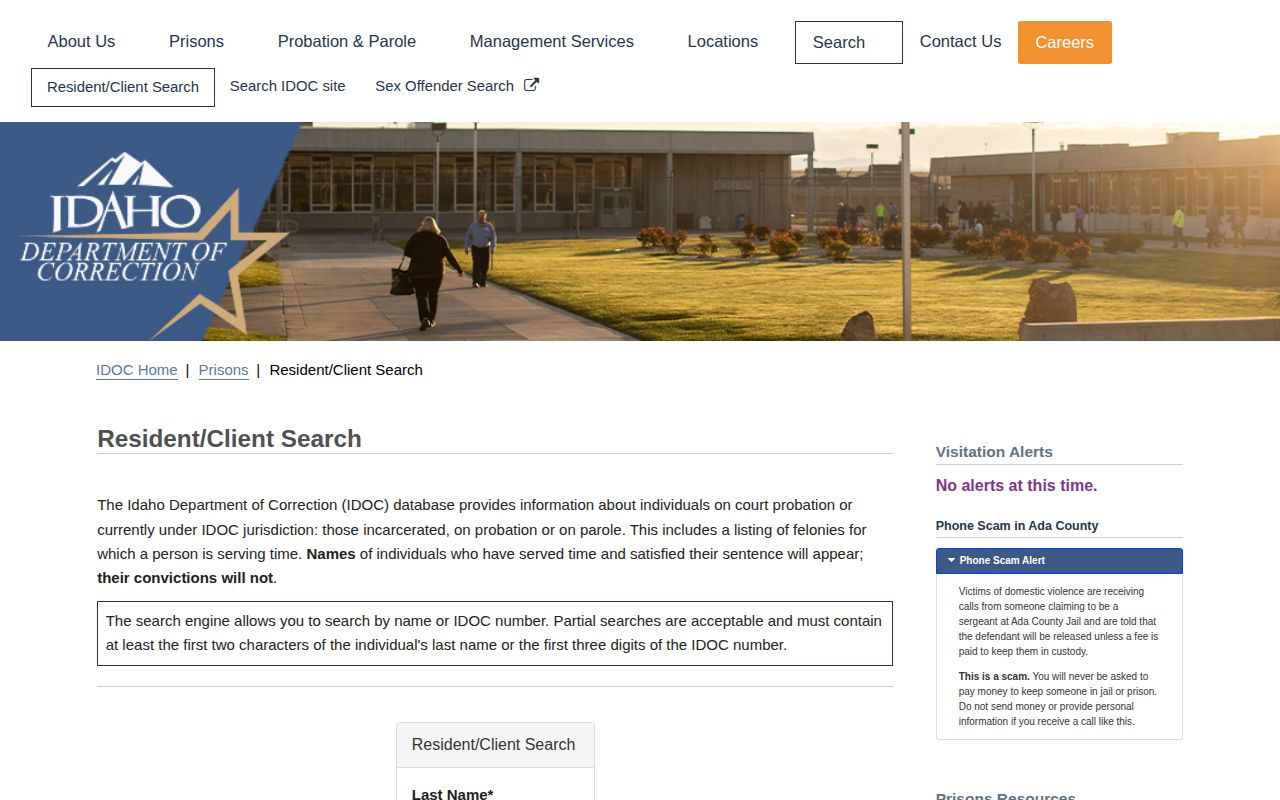
IDOC updates daily but warns that status, location, and scheduled termination information can change faster than the public page.
Note: A daily update is not real-time Bingham County release confirmation when the expected event is today.
Idaho Bingham Release Computation
Idaho Code § 19-2513 requires a state felony judgment to state a minimum confinement period and may add an indeterminate period. The fixed minimum ordinarily must be served before parole eligibility. During it, the person is generally ineligible for parole, discharge, or ordinary good-conduct reduction, apart from narrow statutory exceptions.
Idaho does not have a general modern “85 percent” rule. Research found no broad rule granting state prisoners 15 percent off. Idaho Code § 20-101A contains monthly good-conduct deductions, but its first sentence limits them to offenses committed before July 1, 1986. Those rates must not be used for a current Bingham County estimate.
- Determinate term
- The fixed minimum confinement set by the judgment.
- Indeterminate term
- The later portion when parole may be considered.
- Parole
- Conditional community release while the sentence continues.
- Discharge
- Completion of the sentence status named by the source.
Start with the judgment. Identify fixed and indeterminate terms, concurrent or consecutive structure, and credited custody. Treat the fixed-term end as eligibility, not an exit. An unofficial arithmetic estimate cannot replace IDOC's computation.
Why Bingham Release Dates Change
A tentative parole date can move. Before release, the person must reach eligibility, complete required programming, submit a parole plan, obtain district approval, sign the parole contract, and arrange transport. A rejected plan needs more review. Later Commission action may also alter the grant.
| Factor | Possible effect |
|---|---|
| Programming or plan approval | Can delay tentative parole. |
| Consecutive sentences | Can change the controlling eligibility milestone. |
| Credited custody days | Affect lawful computation. |
| Commission action | May grant, alter, deny, or void a date. |
| Warrant or violation | May suspend parole and lead to confinement. |
| Transfer or detainer | May end one custody without community release. |
Medical parole under Idaho Code § 20-1006 is narrow. It concerns specified permanent incapacity or terminal illness and a required Commission finding. It is not routine good time and should never be inserted into a normal Bingham County date estimate.
Bingham Tentative Parole Dates
The Commission's Notices of Action Taken warn that published parole dates are tentative. Eligibility opens consideration but does not promise release. Even a grant depends on the plan, contract, and other release steps.
Check the Commission date against IDOC after the expected event. Released to Supervision is retrospective and stronger proof that a move occurred, though it can also reflect probation. Sentence Satisfaction Date is a different, often later endpoint.
The official page below preserves the difference between a public decision and a completed release.
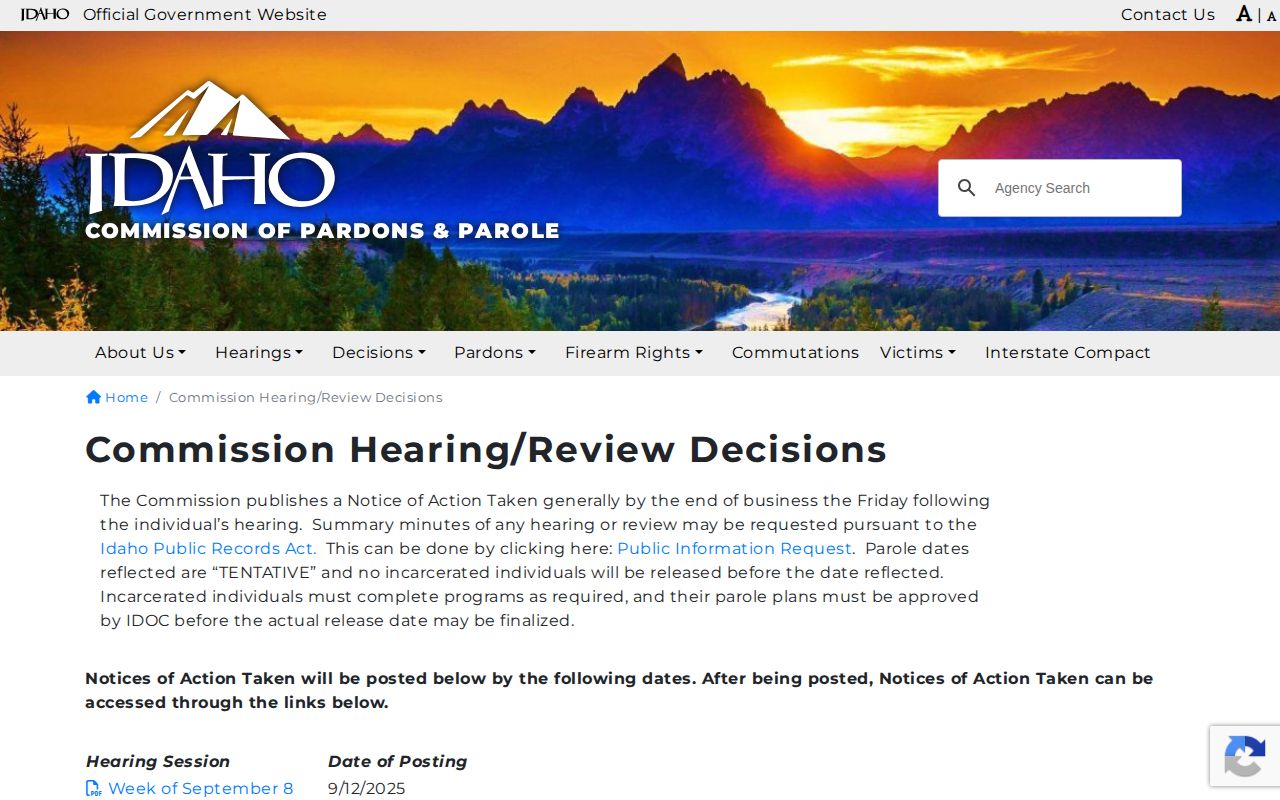
When Commission and IDOC entries seem inconsistent, ask IDOC Records Information or District 7 what each date measures.
Confirm Bingham County Actual Release
For county custody, obtain the Bingham County booking and release record. For state custody, compare Status and Released to Supervision with the judgment and Commission action. State the source agency, date, release type, and any next custodian. That prevents parole, transfer, and final discharge from becoming one vague claim.
A VINE alert may add timely notice, but delivery can lag. The Bingham County VINELink inmate search explains how to register on one verified record and preserve exact event wording.
A physical release is confirmed after it happens. Until then, describe a Bingham County date by its true label: eligibility, tentative parole, hearing, projected termination, or satisfaction. That small distinction prevents a planned event from being reported as fact.
Note: A Bingham County projected release remains conditional until the responsible jail or IDOC record confirms the completed event.
Bingham Release Records Fallback
When a public date is missing, request the existing record instead of asking an office to predict the future. For Bingham County custody, identify the person, booking number if known, confined date range, and court case. Ask for the actual release entry, release disposition, releasing authority, and receiving agency when a transfer occurred. Records can be reached at 208-782-3082. Inmate Information and Booking can first help identify whether the request belongs with the jail.
For IDOC, use its linked Records Information portal. Give the full name, IDOC number, sentencing county, case number, and a narrow range. Ask for public records that show the actual release or discharge date, legal release type, sentence computation, and satisfaction information. IDOC may redact exempt medical, treatment, victim, security, or investigative material. A focused request for basic date fields is more useful than a demand for the entire correctional file.
The court record answers a different question. It can show the judgment, credited custody, parole-related order, dismissal, bond, or discharge authority. It may not prove the hour that jail staff completed physical release. Compare the entered legal event with the custodian's record. If only a satisfied name trace remains in IDOC, the court case number is the best bridge to the older judgment and later orders.
These channels also correct bad assumptions. No result in a live roster does not prove release. A future sentence satisfaction date does not prove current custody. A Commission notice does not prove that all release steps finished. Bingham County release research is strongest when each date keeps the meaning assigned by its source.
Bingham Release Paths by Custodian
A county sentence and an IDOC sentence do not use the same calculation path. Bingham County Detention can confirm jail custody, county-sentence processing, and the physical release record. The county does not publish a verified rolling release archive or a public release-date calculator. For a pending case, the court order and jail processing control. Bond release ends jail custody while the case continues, and it is not sentence satisfaction.
An IDOC commitment is a transfer into state correctional custody. The state judgment's fixed and indeterminate terms, lawful custody credit, Commission action, and IDOC computation then matter. Pocatello Women's Correctional Center is an IDOC prison, while Bonneville and Bannock are neighboring county jails. Moving to one of those locations is not a Bingham County community release.
Federal and immigration holds require separate care. The BOP locator may display a release date for federal custody, but a “Not in BOP Custody” result does not exclude another jurisdiction or supervision. ICE's public locator is a current-detention search, not a projected-release archive. If the Bingham County record names a receiving custodian, follow that agency rather than continuing to calculate from the county booking date.
A sound answer states the scope: “tentative parole from IDOC,” “expected end of a Bingham County jail term,” or “sentence satisfaction.” It does not merely say “release date.” Precise labels make later verification possible and prevent a transfer, hearing, or eligibility milestone from becoming a false promise.